Fichte's method of intermediaries
Fichte concludes section §4.D of his 1794 Foundation (Grundlage der gesamten Wissenschaftslehre) with a "Note" ("Anmerkung"), in which he discusses the methodology of his text. Like the introductory section to §4, which outlined the method of analysis and synthesis that the Theoretical Part will follow, this Note outlines a similar, though distinct, process which we can call the method of "intermediaries" (Mittelglieder). Fichte tells us that this method is intended to show us "from another side, the business of the Science of Knowledge" ("Diese Bemerkung zeigt uns von einer neuen Seite das Geschäft der Wissenschaftslehre"). Understanding the method Fichte outlines here is crucial to understanding Fichte's argumentation in §4.E. Fichte's explanation of the method of intermediaries helps to explain several aspects of his argument that do not appear to be explained by his method of analysis and synthesis, including why he doesn't synthesize the concepts of causality and substance, and why, at the conclusion of the synthesis of substance he seems to entirely change course in his method, shifting from a method of synthesis to his "pragmatic history of the human mind" that we see in the "Deduction of Representation". At the same time, Fichte doesn't completely follow through on his described method of intermediaries. Nor, as we will see below, is Fichte's method of intermediaries entirely consonant with his method of analysis and synthesis.1 The actual exposition in §4.E is a composite image of both of these methodologies that offers Fichte a framework for developing his argument in which he moves freely between the methodological structures he defines, sometimes following them, sometimes following them in a trivial way, and sometimes departing from them in significant ways.
The method of intermediaries
First we are going to explain Fichte's method of intermediary on a highly abstract level, before seeing how this plays on more concretely. The method of intermediaries consists in embarking on an impossible task, namely the unification of opposites, the Self and the Not-Self. Fichte generates a reductio ad absurdum that consists of the following steps:
- Insert an intermediary (Mittelglied) between the Self and the Not-Self on which both "act", but without needing to interact directly.
- Observe that within this intermediary, there must be a way in which the opposites do interact directly
- Insert a new intermediary within the previous intermediary that can explain the supposed direct interaction via an new intermediary that makes the interaction indirect
- And so on, ad anfinitum
From this, Fichte concludes that the Self and Not-Self, in fact, cannot interact at all, and therefore the Not-Self does not exist at all, at least not as a separate entity interacting with the Self:
because the Not-Self cannot in any way be unified with the Self, there ought to be no Self-Not at all...
es soll, da das Nicht-Ich mit dem Ich auf keine Art sich vereinigen läßt, überhaupt kein Nicht-Ich sein...
What then is the relationship between the Self, if it is not that of interacting entities? Fichte offers this analogy as a solution:
Light and darkness are not opposed at all, but rather only a difference of degree. Darkness is merely a very small quantity of light. - Precisely in this way are the Self and Not-Self related.
Finsternis ist bloß eine sehr geringe Quantität Licht. - Gerade so verhält es sich zwischen dem Ich, und dem Nicht-Ich.
If we draw out Fichte's analogy, we can say that the Not-Self and the Self are always, already unified. Just as there is never anything like "pure light", there is also nothing like "pure Self." I argue that we can cash this out in terms of negation. If we understand negation to be internal to a proposition, then we can see how objectivity exists not as opposed to the subject, but internal to it, expressed in terms of a certain "degree" of force that negation does or does not exercise from within the proposition. The ability to "posit", i.e. to put forth a proposition about what is, empirically, the case is the power of 'Selfness.' The truth of the prosition, i.e. whether or not the negation of the proposition comes to bear, is the measure of the "Not-Self". The "Not-Self" is, simply put, negation, and just as negation is not some entity in itself, but rather dependent upon and dwelling within the proposition of what the subject is claiming is the case, so to, is the Not-Self not some entity, some self-standing "world" or "Thing in Itself" standing over and against the Self, but rather a feature internal to the Self's act of positing.
The path that Fichte has outlined casts the entire Theoretical Part of the Foundation in a very different light from what the reader thus far has understood. Fichte is claiming here that the very premise of the Theoretical Part, the Theoretical Principle that the "Self posits itself as determined by the Not-Self", is based on a misunderstanding. The Theoretical Principle assumes a dualism between the Self and the Not-Self, when in actuality, Fichte's true aim is to demonstrate a monism, a deeper fundamental unity between the Self and Not-Self, the mind and the world, thinking and being.
Fichte's method of intermediaries as a reductio ad absurdum helps us to understand why Fichte seems to change gears at the conclusion of the synthesis of substance in §4.E, abandoning his method of synthesis and switching to his "Deduction of Representation". We will recall that the Fichte's method of analysis and synthesis looks like this: [simplified image of analyses and syntheses] When he initially introduces the concepts of causality and synthesis, Fichte claims that causality and synthesis are opposed to one another, each concept capturing one of two "opposed propositions" ("entgegengesetzten Sätze") that are contained in the Theoretical Principle. Causality captures the idea, contained in the Theoretical Principle of a Not-Self "determining" the Self, and substance captures the opposed idea, also contained in the Theoretical Principle, of the Self "determining" itself. One would thus expect that Fichte would, at the conclusion of §4.E, provided a synthesis of these two concepts, thereby resolving the final, overarching contradiction of the Theoretical Principle. If such a final synthesis existed it would look like this: [how Fichte doesn't do things] However, Fichte does nothing of the sort. The synthesis of causality leads to an impass, to a situtation of "not knowing" ("Unwissenheit") how to explain the Theoretical Principle, whereas the synthesis of substance leads out of the framework of analysis and synthesis entirely, rejecting the dualist assumption that underlies the Theoretical Principle, and moving to a new monist theory that tracks the development of an "infinite activity" of the Self.2
The method of intermediaries in detail
The first step of the method of intermediaries is to introduce a first "intermediary" that can "mediate" between the absolute opposition of Self and Not-Self. Fichte calls this first intermediary X:
The genuine, highest task, which contains all subordinate tasks is to explain how the Self can act directly on the Not-Self, and the Not-Self directly on the Self, for they are supposed to be entirely opposed to one another. We insert between both some X, which both act upon, and through which both at the same time indirectly act of each other.
Die eigentliche, höchste, alle anderen Aufgaben unter sich enthaltende Aufgabe ist die: wie das Ich auf das Nicht-Ich, oder das Nicht-Ich auf das Ich unmittelbar einwirken könne, da sie beide einander völlig entgegengesetzt sind. Man schiebt zwischen beide hinein irgendein X, auf welches beide wirken, wodurch sie denn auch zugleich mittelbar auf einander selbst wirken.
Thus we have the following diagram:
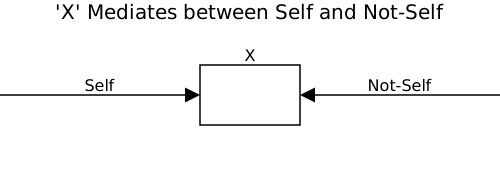
Fichte's choice of variable, "X" is important here, because he uses the same variable name in defining substantial exchange:
We have now identified an X which is simultaneously reality and negation, activity and and suffering. a. X is activity, in so far as it references the Not-Self, because it is activity that is posited in the Self, and in the positing, acting Self. b. X is suffering, in so far as it references the totality of action.
Es ist jetzt ein X aufgezeigt worden, welches Realität und Negation, Thätigkeit und Leiden zugleich ist. a. X ist Thätigkeit, insofern es auf das Nicht-Ich bezogen wird, weil es gesetzt ist in das Ich, und in das setzende, handelnde Ich. b. X ist Leiden, insofern es auf die Totalität des Handelns bezogen wird.
The "X", the "intermediary" between the Self and the Not-Self is thus the "interdetermination", here 'substantial interdetermination' between the Self and the Not-Self. The Self "acts" on the Not-Self insofar as it alone posits, i.e. determines the Self through the act of empirical judgment. The Not-Self "acts" on the Self insofar as the Self must commit itself to a single judgment, p, which excludes all contraries to p. Thus we can map out substantial interaction as an intermediary like this:
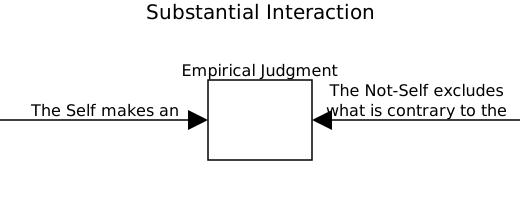
The intermediary here is, generally speaking, empirical judgment, and parallel to the substantial construal of empirical judgment, Fichte has already defined, in §4.C the causal construal of empirical judgment. The causal intermediary looks like this:
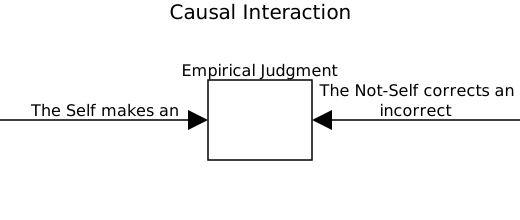
The next step in the method of intermediaries is recognize that this X, this first intermediary, doesn't solve the problem it was supposed to solve, and that a second intermediary, as Y, is needed:
Soon, however, one discovers that in this X there must, in fact, be another point in which the Self and the Not-Self directly meet. In order to avoid this, we insert between, and in place of the sharp border a new intermediary = Y.
The "point in which the Self and the Not-Self directly meet" in fact occurs twice, on either "end" of the intermediary X. Thus Fichte says, concerning the synthetic concept of substantial exchange,:
Es ist demnach, wie das bei jeder Synthesis zu geschehen pflegt, in der Mitte alles richtig vereinigt und verknüpft; nicht aber die beiden äussersten Enden.
Thus, as happens with every synthesis, everything is in the middle correctly unified and connected; not, however, the two outermost ends.
This is to say that the contradictions that continue the reductio ad adbsurdum occur in two places, first between the Self and intermediary of empirical judgment and, second, between the Not-Self and the intermediary of empirical judgment. This can be illustrated as follows:
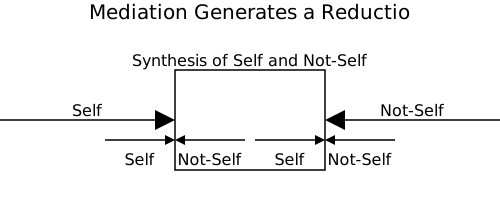
Fichte gives us three examples of how this second contradiction plays out. The first example is in his analogy of light and darkness, which is meant to illustrate, metaphorically, how the analyses and syntheses of causality and substance will work. Then he actually applies this method in the respective analysis and synthesis of causality and substance.
The analogy of light and darkness
Fichte's analogy of light and darkness equates light with the Self and darkness with the Not-Self, and begins the method of intermediaries by introducing "twilight" as the intermediary between darkness and light:
Posit in the continuous space A in point m light, and in point n darkness: because the space is continuuous and there is no hiatus between m an d n, there must be a point o between the two points which is simultaneoulsy light and darkness, which is a contraiction. Posit between both an intermediary, twilight.
Setzet in dem fortlaufenden Raume A im Puncte m Licht, und im Puncte n Finsterniss: so muss nothwendig, da der Raum stetig, und zwischen m und n kein hiatus ist, zwischen beiden Puncten irgendwo ein Punct o seyn, welcher Licht und Finsterniss zugleich ist, welches sich widerspricht. – Ihr setzet zwischen beide ein Mittelglied, Dämmerung.
We can sketch Fichte's analogy like this:

The next step in the reductio is to identify that the same contraction now plays out on either side of the twilight:
It [i.e. the twilight] would go from p until q, so that in p, twilight borders light, and in q, twilight borders darkness. However, you have thereby merely postponed the contradiction instead of finding a satisfactory resolution. Twilight is a mixture of light and darkness. In p, the bright light can now only border twilight in the sense that in p, light and twilight exist simultaneously; and because twilight is only different from light insofar as it also is darkness; - then it [i.e. point p] is both light and darkness. And the same thing for point q.
Sie [d.h. Dämmerung] gehe von p bis q, so wird in p die Dämmerung mit dem Lichte, und in q mit der Finsterniss grenzen. Aber dadurch habt ihr bloss Aufschub gewonnen; den Widerspruch aber nichtbefriedigend gelöst. Die Dämmerung ist Mischung des Lichts mit Finsterniss. Nun kann in p das helle Licht mit der Dämmerung nur dadurch grenzen, dass der Punct p Licht und Dämmerung, zugleich sey; und da die Dämmerung nur dadurch vom Lichte unterschieden ist, dass sie auch Finsterniss ist; – dass er Licht und Finsterniss zugleich sey. Ebenso im Puncte q.
We can sketch out this process as follows:

At this point, the next thing to do would be to introduce new "intermediaries" that would mediate between, respectively, light and twilight, and darkness and twilight. However, because the futility of such a move has already be demonstrated, the reductio ad absurdum is complete, justifying now the paradigm shift to a complete rejection of the dualism between light and darkness:
Thus the contradiction cannot be resolved at all except lihgt so: light and darkness are not opposed at all, but rather only a difference of degree. Darkness is merely a very small quantity of light. - Precisely in this way are the Self and Not-Self related.
Mithin ist der Widerspruch gar nicht anders aufzulösen, als dadurch: Licht und Finsterniss sind überhaupt nicht entgegengesetzt, sondern nur den Graden nach zu unterscheiden. Finsterniss ist bloss eine sehr geringe Quantität Licht. – Gerade so verhält es sich zwischen dem Ich, und dem Nicht-Ich.
The analysis and synthesis of causality
In the analysis and synthesis of causality, we recall that we begin with empirical judgment as the intermediary between the Self and the Not-Self:
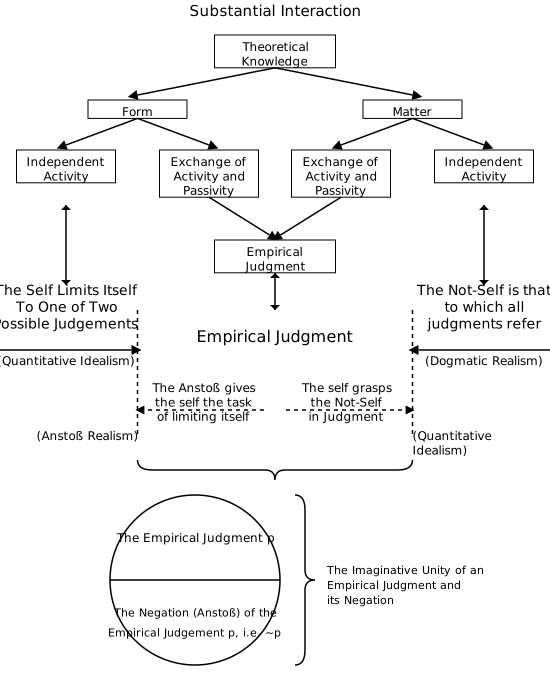
In §4.E., Fichte then defines another term, an "independent activity", which he splits into an "independent activity of the Self" and an "independent activity of the Not-Self". If we replace "activity" with "reality", then we can understand these terms to mean that the Self and the Not-Self each have a reality that is independent of whatever it judged to be the case. The "independent activity of the Not-Self" says that the world has a reality that is independent of whatever the Self judges is the case in the world. The "independent activity of the Self" says that only the Self can judge what is the case, meaning, that regardless of the truth of this or that empirical judgment, reality is only present through the act of judgment, an act which the Self alone accomplishes, independantly of the truth or falsity of a particular judgment. The interplay of Self and Not-Self that was defined in the act of empirical judgment as a way to mediate between the contradiction of Self and Not-Self, now finds new contradictions in asking how these two "independent activities" each interact with empirical judgment. We can sketch out the situation as follows, in analogy to the analogy of light and darkness:

The interaction between the reality of the Self and empirical judgment seeks to answer the question of how, if what the Self judges,automatically has reality, is there space for incorrect empirical judgment? Fichte answers this with his theory of quantitative idealism, which says that every empirical judgment understands itself to be fallible, to be potentially incorrect. The interaction between the reality of the Not-Self and empirical judgment seeks to answer the question of how the Not-Self weighs in on the truth or falsity of empirical judgment, correcting those judgments that are incorrect. Fichte's answer here is the theory of quantitative realism, which is that the Not-Self does, in some way, add a "determination" to empirical judgment, which, based on how Fichte has defined his termed, would be the correction of incorrrect judgment. We can locate the theories of empirical judgment within the method of intermediaries like so:

And this maps onto the method of analysis and synthesis as follows:
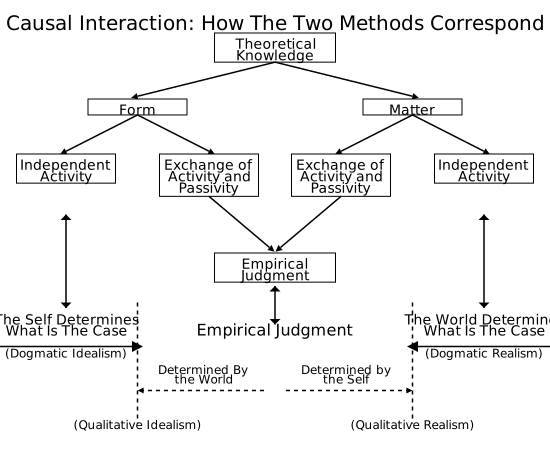
Fichte concludes the synthesis of causality by saying that neither theory is sufficient. The intermediary of empirical judgment reveals on both the sides of judgment, i.e. on the side of thinking and the side of being, the same problem that afflicted the initial conflict between judgment and being, namely how, on the one hand, judgment gains traction on that which is truly the case, and how, on the other hand, the world weights in on, is capable of determining an act that is, allegedly, entirely the work of the mind.
The analysis and synthesis of substance
The analysis and synthesis of substance starts looks, on the face of it, similar to that of causality, in terms of how it applies the method of intermediaries, for it, too, defines the "exchange" as the intermediary between the Self and the Not-Self, and then proceeds to define a formal and material "independent activitiy" that improves, but does not resolve the conflict between the Self and the Not-Self. However, in the end it completes the paradigm shift to a new conception of Self and Not-Self, wherein there is no Not-Self, but rather, only negation as a function internal to any empirical judgment.
We will recall that Fichte defines substantial exchange in terms of the "intermediary" (Mittelglied) "X" that relates to the Self and the Not-Self as follows:
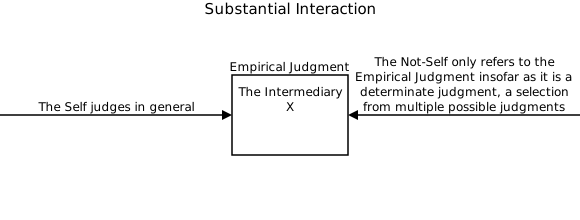
Fichte begins the "Note" at the conclusion of §4.D with his intention to capture the new contradictions that now arise "on both outmost ends" (die beiden äußsersten Enden) of the exchange:
The activity of the Self, by means of which it differentiates and compares itself as substance and accidence remains unexamined and completely unknown; as is that which prompts the Self to understand this action; this latter aspect may be, as far as we can assume from the first synthesis, an effect of the Not-Self.
Ununtersucht und völlig im Dunkeln ist gelieben teils diejenige Tätigkeit des Ich, durch welche es sich selbst als Substanz und Akzidens unterscheidet, und vergleicht; teils dasjenige, was das Ich veranlaßt, diese Handlung vorzunehmen; welches letztere, soviel wir aus der ersten Synthesis vermuten können, wohl eine Wirkung des Nicht-Ich sein dürfte.
We can sketch out Fichte's suggestion like so:
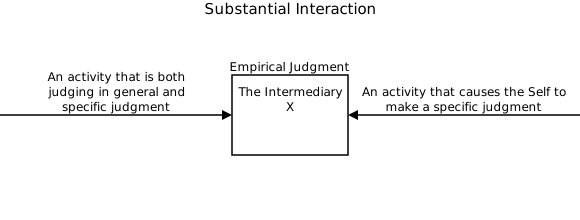
Fichte's language in the "Note" anticipates the monist theory of imagination and the check that emerges at the conclusion of the synthesis of substance. The "activity" that "differentiates and compares" "substance and accidence" turns out in §4.E, in the synthesis of substance, to be the imagination. The imagination is "that most wonderful capacity" ("das wunderbarste...Vermögen") with which the Self can "hold onto the disappearing accident long enough to compare it with that which it is suppressed". The imagination allows the Self to, in the face of a judgment p that is has made, consider the possibility of a contradictory judgment q. Stated more generally, the imagination holds onto the totality of judgments, which includes all possible judgments, including conflicting judgments, but without loosing the specificity of each judgment, including both those judgments that it has determined to be true, and those judgments that are counter to fact. In this way, the imagination is the capacity, or "activity of the Self", by means of which it "distinguishes and compares itself as substance and accident". The Self is a "substance" because it imaginatively considers all possible judgments, and it is an "accident" because it takes specific judgments to be the case, and others to not be the case.
The second "unexamined" element that Fichte refers to in the "Note", turns out, at the conclusion of the synthesis of substance in §4.E, to be the "check" (Anstoss) on the "infinite activity" of the Self. The "check" on the Self is what brings the Self into the "hovering" of "positing itself as infinite and finite". This "hovering" is the activity of imagination, which the "positing itself as infinite" is the Self considering itself as "substance", as the source of all possible judgments, and the "positing of itself as finite" is the Self considering itself as an "accident", as committed to a subset of all possible judgments. Fichte's choice of language of something that "prompts the Self" (das Ich veranlaßt) to make a determinate judgment foreshadows the notion of the Check as something that doesn't itself "determine" judgment, but rather gives the Self "the task of determination" (die Aufgabe der Bestimmung). Whether, as Fichte hints, this 'prompt' is an "effect of the Not-Self" (Wirkung des Nicht-Ich) is only answered in the final synthesis of substance, where it turns out that such a formulation of a Not-Self acting on, i.e. affecting (wirken, Wirkung des Nicht-Ich) reifies something that in fact is only internal to the judgment itself in the form of negation. Thus the paradigm shift will go from this:
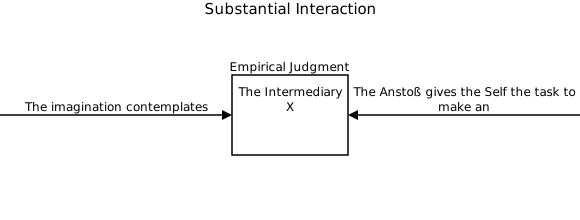
to this:
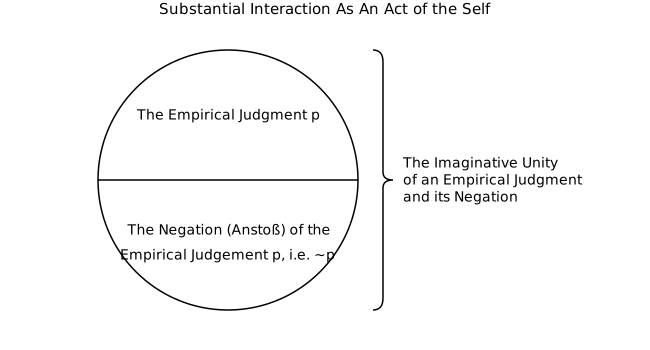
Between the "Note" and the final theory, however, lies the detailed analysis and synthesis of substance, in which the new "intermediaries" make an appearance as Fichte's definitions of "independent activity". However, Fichte's definitions of these entities are inconsistent, in a state flux. This is likely because Fichte, on the one hand, plans to reject the dualism of Self and Not-Self, to exit out of the reductio ad absurdum, only in the Practical Part of the Foundation, but, on the other hand, ends up in fact shifting the paradigm at the conclusion of the synthesis of substance, which is still in the Theoretical Part. The state of flux, for example, is evident in how he defines the two "independent activities" of substantial interaction. In the section where he first introduces the concept of "independent activity", he distinguishes between two independent activities of substantial interaction: 1) "imagination" (Einbildungskraft) or "absolute activity that determines an exchange" (absolute Thätigkeit, die einen Wechsel bestimmt) and 2) "divestment" (Entäußern), or the act of excluding, i.e. not positing some part of the total activity (Es wird ein bestimmtes Quantum der absoluten Totalität von der als vermindert gesetzten Thätigkeit ausgeschlossen). These two activities are clearly activities of the Self. In contrast, the two independnet activities of causality that Fichte defines in this seciton are, respectively, an activity of the Self and of the Not-Self. Thus Fichte does not identify anohter activity of the Not-Self in his initial formulation of the two "independnet activities" of substantial interaction. Later, in the final analysis, however, he corrects this, identifying the two independent activities of substantial interaction as 1) the Self's act of "exclusion" (Ausschließen), ie. similar to the "divestment" (Entäußern) he defined earlier and 2) the activity of an "more comprehensive, but undetermiend sphere" which he equates with the Not-Self. The sphere is "undetermined" because the Self has yet to bring make a judgment that brings the determinate world, the Not-Self into view. The idea seems to be here that the Not-Self is that to which all empirical judgments, correct or not, must refer. The final structure that Fichte presents for substantial interaction can be sketched as follows:
A close reading of this analysis and synthesis of substance I offer in a different blog post devoted to this topic.
-
In Hölderlin und Fichte Violetta Waibel sees the method of intermediaries as a metaphorical "image" of the method of analysis and synthesis:
Der Konstruktionsweg, den Fichte im theoretischen Teil der Wissenschaftslehre zurücklegt, läßt sich durch ein Bild verdeutlichen, das er selbst in einer Seitenbemerkung gebraucht. (Waibel 303)
I argue that we need to differentiate these two methods. ↩︎
-
Fichte writes:
↩︎Es ist das Resultat unserer soeben aufgestellten Synthesis, dass beide Unrecht haben; dass jenes Gesetz weder ein bloss subjectives und ideales, noch ein bloss objectives und reales sey, sondern dass der Grund desselben im Object und Subject zugleich liegen müsse. Wie er aber in beiden liege, darüber ist die Untersuchung vor der Hand abgeschnitten, und wir bescheiden uns hierüber unserer Unwissenheit...