The Canonical Form
A Commentary on the Phenomenology of Spirit
Table of Contents
- Introduction
- Theoretical Philosophy
Introduction
1. The Canonical Form of judgment is S is F.
e.g. "The sky is blue", "The cube is red", etc.
Wittgenstein calls this a Fact (Tatsache). "Die Welt ist die Gesamtheit der Tatsachen, nicht der Dinge."
2. Theoretical Philosophy is the analysis of the Canonical Form. Practical Philosophy is the employment of the Canonical Form.
The Canonical Form consists of the combination of a subject (S) and predicate (F).
Frege calls the subject the "object" (Gegenstand), the predicate the "concept" (Begriff).
e.g. "The apple is red". We predicate the concept "red" of the object, the "apple".
e.g. "This is red". The object is a "This", Hegel's "Thing."
We employ the Canonical Form when we expand S is F to say "I think (S is F)", "She thinks (S is F)", "We think (S is F)". This is practical philosophy. Practical philosophy is self-conscious and inter-subjective.
3. The distinction between Theoretical Philosophy and Practical Philosophy is only a heuristic.
To think (S is F), i.e. to think p is to place onself in agreement with p. We have in the ambiguity of the term "agreement" the unity of theoretical and practical philosophy. In its theoretical, or logical-practical, inflection, "I agree with p" is neutral with respect to the desirability of p. It is simply an acknowledgment of something being the case, even if that thing is evil. However, agreement is more fundmentally an act of good will. It is the grace that is at the root of "agreement": "gratum est mihi". It is pleasing, welcome to me. To express agreement with p is for me to give p my blessing. This is the moral-practical truth of my own commitment to any judgment p. There is no agreement with a judgment p unless this agreement derives from a more fundamental acceptance, an embrace of the way things are.
This practical sense of "agreement" that, in fact, underlies the apparently merely theoretical, or logical-practical, unity of apperception "I think p" is expressed in the creation story. God creates the light, he sees the light, and he calls it good:
וַיַּרְא אֱלֹהִים אֶת-הָאוֹר, כִּי-טוֹב
Seeing that p and seeing that p is good are same act.
This of course leads to the problem of evil. Are there evil facts? Can I think p if p is evil? At the limit, the answer is no. True evil has no logos. However, in daily life, many of the things we think we think we disapprove of. This is only possible insofar as we have experienced of the good, an experience which is originally given to us in the form of the care our parents have for as children. It is this experience of the good that allows us to take that original leap of faith, to identify ourselves with the thought we are having, to have a thought "p" and call it good. Without this leap of faith, enabled in the bosom of the Good, we would not commit to any thought. It is this faith in the good that gives us the strength to ascertain the bad, to accept something bad in the world, without a complete loss of faith, and with it, a loss of thinking.
Why is Kimhi careful about "I think p" as agreement with p? Kimhi restricts "agreement" to an agreement among facts, but not my agreement with a single fact:
judging that p is inseparable from a consciousness of its agreement with whatever else I think. (Kimhi 53)
Kimhi appears unprepared to assert the underlying moral-practical meaning of agreement as endorsing, calling p good.
Neverthlesss, Kimhi does invoke the logical-practical side of p in terms of employing p:
logically compound assertions such as p → q are acts of identifying our consciousness as agreeing or disagreeing with the combination (and their negations) displayed by the subordinate judgments. (Kimhi 56)
The canonical form of judgment S is F can be expressed in its employment as p.
Kimhi calls ¬p an "operation" on the "subordinate judgment" p. In the judgment ¬p, p is "displayed", while ¬p is what is asserted.
¬p says "I disagree with p". p says "I agree with p".
Kimhi says: "The judgment p & q is an identification of consciousness as containing both p and q, and so as disagreeing with any combination of judgments that contains either not-p or not-q."
The logical expansion of the simple judgment p into I think p and I disagree with ¬p demonstrates that Theoretical Philosophy and Practical Philosophy unite in the canonical form of judgment. Theoretical philosophy is concerned with the parts and unity of p, the parts and unity of S is F. Practical philosophy is concerned with the expansion of p.
Kimhi points out that "I think p" is an expansion, an employment of p. Hegel will claim that "p is good" is a more basic expansion of p without which I think p would not be possible. This is Fichte's "primacy of the practical".
Theoretical Philosophy
The first three chapters of the Phenomenology of Spirit are devoted to theoretical philosophy.
Hegel constructs the Canonical Form of Judgment S is F as follows:
- Sense Certainty: We are introduced to F.
- Perception: We are introduced to S.
- Force and Understanding: We are introduced to S is F ⇔ p.
Sense Certainty
We begin in the here and now, "Itzt" and "Hier", hic et nunc.
We begin with a name, "night", "Nacht": "Das Itzt ist die Nacht".
We name the here and now "night".
Frege would say: we employ the "concept" "night."
Kant calls this the "Subsumtionen eines Gegenstandes unter einen Begriff".
The "object" is the "now", the concept is "night".
"Das Itzt ist die Nacht" follows the canonical form S is F.
Naming is an employment of language. Hegel calls language "das Allgemeine" (the universal).
In naming that which is here and now, we connect language to that which is given in intuition, to that which is sensuously present.
This is an example of what Kimhi calls "the logical-sensible unity of language".
Hegel says of naming: "Als ein Allgemeines sprechen wir auch das Sinnliche aus..."
I find myself in the here and now. That which is here and now is "das Sinnliche".
It is nighttime where I find myself. I name the here and now "night". I employ language, "the universal" to name my sensuous reality.
Walter Benjamin says of naming: "Gottes Schöpfung vollendet sich, indem die Dinge ihren Namen vom Menschen erhalten, aus dem im Namen die Sprache allein spricht." In this first act of naming, everything else in language is also given. Language, in humans, (already) speaks in the name.
Perception
In naming that which is present before us, we have not yet exhaustively described, in language, our experience.
"It is night", but it is also many other things.
"Die unmittelbare Gewißheit nimmt sich nicht das Wahre, denn ihre Wahrheit ist das Allgemeine, sie aber will das Diese nehmen."
My truth is the universal. My truth is "night", "It is night." But "It", this is also many other things.
S is night. Is S only night? Of course not! S is many other things.
As long as S is the here and now, S is the sum total of my sensuous experience, that which Kant calls the "manifold of intuition".
Let us narrow down the here and now. Let us choose a simpler S, a single grain of salt: "Dies Salz ist einfaches Hier".
Let us now see if we can capture, in language, the this, the here and now on which I train my focus. As before, we are strictly here to canonical judgments of the form S is F:
- Here is a grain of salt.
- The salt is white.
- The salt is sharp.
- The salt is cubic.
- etc.
Have we exhaustively captured the this, the grain of salt I see before me?
- "Here is a grain of salt". True, but I am not referring to any grain of salt. I am referring to this grain of salt, here.
- "This salt is white". True, but it more than simply white. It is this particular white. It is these manifold hues of white that dance before my eyes.
- etc.
The grain of salt is "der Punkt der Einzelheit in dem Medium des Bestehens in die Vielheit ausstrahlend."
-
"The point of singularity". The grain of salt is one, it is unity, a single point of reference, which we can designate as S.
-
"in dem Medium des Bestehens": The grain of salt is a sensuous unity. It holds countless attributes: that white there, this white here, that cubic shape, that sharp edge. "white", "sharp", "cubic" exist "in the grain of salt". The grain of salt is a "medium" in which many different attributes coexist.
-
"in die Vielheit ausstrahlend": From the single grain of salt, the S of S is F, the many attributes emanate out, like rays of the sun. The sun is the S in S is F, the "point of singularity". The rays are the propositions:
- S is F1
- S is F2
- S is F3
- etc.
S is an object. It is the bearer of properties.
The properties F1, F2 are conditional. They are conditional upon the sensuous experience which they name. An F is a "mit einem Gegensatze affizierte Allgemeinheit." The sensuous presence of white is the guarantor of our name white. The sensuous presence of white "handles", "treats" (afficere) the correct employment of its name. It honors the name "white" as the linguistic truth of its sensuous presence.
S of S is F is not conditional upon any single property Fn. S, as the bearer of any one of the many F's, stands above any particular F, any particular sensuous property which we predicate of S.
S is "die unbedingte absolute Allgemeinheit".
- S is unconditional because not conditioned by sensibility.
- S is absolute, because it exists in itself (an sich). It is the invisible point from which emanate the many judgments S is Fn.
- S, the This, only makes itself known through its attributes, Fn.
- The F is the mask, the appearance, the S is the thing behind the mask, the Ding an sich. S is the invisible bearer of the visible Fn
- S is universality (Allgemeinheit) because it is linguistic. It is the grammatical subject of the canonical form of judgment S is F.
This is Hegel's exact wording:
-
"Aus dem sinnlichen Sein wird er [der Gegenstand] ein Allgemeines": The act of naming, introduced in Sense Certainty. "This is night." "That is a house." The sensuous object is named, it becomes "a universal", an exercise of language.
-
"Aber des Allgemeine ist, da es aus dem Sinnlichen herkommt wesentlich durch dasselbe bedingt, und daher überhaupt nicht wahrhaft sich selbst gleiche, sondern mit einem Gegensatze affizierte Allgemeinheit...": When I name the thing, "This is a house", I employ the indexical "this". My use of the name "house" is tied to the this, the sensuous presence. The word "house", spoken in the act of naming this house, is language that is handled (affected, treated) by its opposite. The opposite of language is physical reality, objects in time and space.
-
"...dies Allgemeine ist...mit einem Gegensatze affizierte Allgemeinheit, welche sich darum in die Extreme der Einzelheit und Allgemeinheit, des Eins der Eigenschaften und des Auch der freien Materien trennt.":
-
I name the this: "This is a tree."
-
Because I am still employing the indexical this, I am still standing before the tree. My name "tree" is still "affected" by the tree before me.
-
I keep looking at that which I can name "tree" and some other names occur to me: This is (also) green. This is (also) brown. This is (also) tall.
-
The This is now the unity of all these names. It is the singular object (Einzelheit) of which all of my judgments are true. It is the "Eins der Eigenschaften", the This of:
- This is a tree
- This is green
- This is brown
- This is tall
-
This has also become "universal" (all-gemein = "referring to all") because the This encompasses many names, viz.:
- ...tree
- ...green
- ...brown
- ...tall
The This is thus: a tree AND green AND brown AND tall. The This is the "and" (das Auch) of the many things.
-
-
"Diese reinen Bestimmtheiten scheinen die Wesenheit [des Gegenstsands] selbst auszudrücken, aber sie sind nur ein Für-sich-sein, welches mit dem Sein für ein Anderes behaftet ist": There are two "determinations of the object:
- Determination 1: This. "das Eins der Eigenschaften". The unity of the predicates "tree", "green", etc. The This that unities all the predicates.
- Determination 2: The many predicates, held together with "and": This is a tree, and green, and brown, etc. "das Auch der freien Materien". Both Determination 1 and 2 are "being for itself". They are expressions of language, of a name in language. Being becomes "for itself" when it names what is.
Both Determination 1 and 2 are, however, "afflicted" (behaftet) with "being for another". The This of "This is a tree" exists, also, for other predicates. The "tree" must share its This with other predicates. The name "tree" is not the entire truth of the This. "This" is a tree "and" green "and" brown, etc.
- When employing "This" in the subject position "This is a tree", the canonical form is an open form. It shares its subject "This" with other possible predicates in the sensuous manifold. The This of "This is F" is linguistically speaking open, or undetermined. To know what This I am talking about, you have to see me pointing to something in sensibility.
-
"indem aber beide wesentlich in einer Einheit sind, so ist itzt die unbedingte absolute Allgemeinheit vorhanden, und das Bewußtsein tritt hier erst wahrhaft in das Reich des Verstandes ein." The grammatical subject is the bearer of properties. It is the unity (Eins der Eigenschaften) that can enter, as the self-same bearer into many combinations (das Auch der freien Materien): S is F1, S is F2, etc. Once we recognize the grammatical role that This plays within the canonical form of judgment, S is F, we see that we can replace This with a name: "The tree", or "The plant", etc. And now we can say: "The plant is a tree." "The plant is green." The judgment This is F is the open form of judgment, i.e. open to sensibility, to the this I am pointing to. The judgment S is F in its canonical form, e.g. "The tree is green" is the closed form of judgment. I can state a fact (Tatsache) without the immediate reliance on sensibility. Language, the universal ("das Allgemeine"), has achieved completion, decoupling itself from a slavish dependence on sensibility. It is become "unconditioned" and "absolute".
Force and Understanding (Summary)
With the introduction of the subject, S, from the canonical form S is F, we are now in a position to see the canonical form in its entirety, not just as ... is F, not just as S as a this, i.e. This is F. S is no longer an indexical, pointing to something in experience. S has become language. S is the grammatical subject of the canonical form S is F.
We stand now at the intersection between and unity of Theoretical and Practical Philosophy. S is F is the form of the proposition p. Seen as a unity, S is F becomes the single proposition p.
I. The analysis of S is F is theoretical philosophy.
Sense Certainty was the deduction of F, and F alone. It employed the fiction that naming is not a propositional act, that it does not employ the canonical form S is F. This fiction is only possible thanks to the indexical. The indexicals here, now, and this point to the real world, to intuition. They anchor the S of S is F to the real world, and thereby they secure the truth of S is F.
Kant: "thoughts without content are empty". If I cannot exercise the indexical function of language, if I cannot point to that thing in experience to which my judgment refers, my judgment is not simply neither truth nor false. It is empty.
Only that is true which refers to something given in intuition.
Kimhi calls the parts of S is F categorematic. The parts, S and F, secure the truth of the judgment S is F. S is F is syncategorematic. It is a mistake to think that the parts, S and F could mean anything outside of their employment in the judgment S is F. It is equally a mistake to think that the judgment S is F could mean anything outside of its reference, in intuition, to the parts S and F.
II. The employment of p is practical philosophy.
The canonical form S is F is the form of the judgment p. p is a thought, a Tatsache. p refers to things (Ding). These things only exist for me in the form of facts, propositions, Tatsachen. "Die Welt ist die Gesamtheit der Tatsachen, nicht der Dinge."
p, being a thought, must necessarily expand into the form I think p. It will be the work of Practical Philosophy to show that p being a thought, must also necessarily expand into the form She/He thinks p, We think p, etc.
Is not the I of the judgment I think p real? No. The I is ideal, not real. The I of the I think p, Fichte's I = I is only real to the extent that freedom, morality, and the Good are real, and no further. Fichte's I = I is Practical Philosophy.
III. The unity of S is F ⟺ p is the unity of theoretical and practical philosophy.
Moving us to this unity is the work of the chapter Force and Understanding.
Force and Understanding (Commentary)
The Unconditioned Universal (das unbedingte Allgemeine)
The introduction of the grammatical subject S of S is F marks the cleavage of language from being. So long as we only used indexicals (here, now this), it might have appeared to us that language could only be employed in the presence of physical objects. But now, it turns out that language allows us to speak of facts in the absence of the presence of the things about which they are facts.
I can say "The grain of salt is white", and someone else understands me without requiring that I point to the grain of salt.
The canonical form S is F describes facts (Tatsachen) that refer to things (Dinge).
We can work with facts in the absence of the things to which they refer. Facts are, in this sense "unconditioned". They can stand by themselves. While they refer to things, they can be grasped independently of the immediate, sensuous presence of thing.
The S of S is F is not a physical object. It is a grammatical subject. When I replace the indexical this with a name The grain of salt I cut it off (absolvere) from the physical object to which it refers.
"[das Unbedingte] hat sich als ein solches ergeben, welches aus einem solchen bedingten für sich Sein in sich zurückgegangen ist."
The this is This is F was a "conditioned being for itself". Language is "being for itself". The "self" of "itself" is the I who employs language. When I employ language, I make clear to myself what is the case. When I employ, for example, the indexical this, that this to which I refer becomes present to me, it comes to be "for me", "for my self". Indexicals are "conditioned being for itself" (bedingtes für sich Sein). Indexicals, if they are to refer to anything at all, must refer directly, in their immediate employment, to something in Space and Time.
The grammatical subject S of S is F is not, necessarily, indexical. The grammatical subject S "goes back into itself". "The grain of salt is white" does not, in the act of its utterance point to any particular grain of salt. It has transcended the here and now, the this to which the utterance refers. It still refers to the grain of salt, but can refer to the grain of salt in the absence of the salt.
Although the S of S is F need not be indexical, the S must refer to something in Space and Time, and therefore it is necessary that we, in order to defend the truth of our claim S is F, replace the S with a this, and point to the this in experience. This is why Hegel says that the "unconditioned", the S of S is F, retreats from "conditioned being for itself". To retreat is to relinquish the current position for a new position. "S is F" begins with a "This is F", and then, it retreats from the This to a proper subject "The grain of salt". The canonical form of judgment extricates itself from sensuous immediacy.
While the canonical form S is F extricates itself from the here and now of the indexical This is F, it still depends on the indexical. To ignore the requirement that S must refer to a this or a that in Space and Time is to succumb to the illusion that language is autonomous: "Dies Unbedigte wäre nun selbst wieder nichts anders, als das auf eine Seite tretende Extrem des für sich Seins, wenn es als ruhiges einfaches Wesen genommen würde...". Under such an illusion, the S of S is F need not refer to anything in experience. Language, and the propositions it furnishes, would exist merely in the library as a "quiet, simple being". Rows and rows of books. Under the illusion of linguistic autonomy, the empirical world, empiricism itself, is a crude lie: "denn so träte ihm [i.e. the unconditioned, language as being for itself] das Unwesen [the irreality of the empirical world] gegenüber". However, reality bites. Empirical reality is very much real, it is the only thing that is real: "aber auf dieses [Unwesen - the alleged nonbeing of the empirical world] bezogen wäre es [das Unbedigte, language] selbst unwesentlich, und das Bewußtsein nicht aus der Täuschung des Wahrnehmens herausgekommen..." The canonical form of judgment S is F is language that grasps reality. When reality asserts itself, it asks language to say what is the case. Language gets going: "S is F1, S is F2, ...". None of these assertions exhaust, or even get traction on the physical reality as a physical reality. They are propositions, thoughts, and therefore ideal. What they bring into view is real.
The Game of Knowledge
With the movement from This is F to S is F we give the unity of This a name, S. The This of This is a tree, This is green, This is brown becomes The tree is green. The open form of the indexical This, whose meaning was context-dependent, has given way to the closed form, the canonical form of judgment S is F. Now that we have encoded, in language, our limitation of This to a single object, an S (a house, a tree, a grain of salt), we can play the Game of Knowledge.
Knowledge is the Power.
Rödl: "...the power of judgment is the power, the power überhaupt."
Knowledge is the Human Power, the power to know. Hence humans are Homo Sapiens, people who know, people (viri - men AND women) who have the power (vis) to know.
Before knowledge becomes knowledge of The Good, it is merely a game.
Wittgenstein formulated this game as the game of mere facts in the Tractatus. Once you grasp the game, you can "throw it away." (TLP 6.54). The only perspective from outside this game looking in is the moral perspective. It will render this game senseless. "if a man could write a book on Ethics which really was a book on Ethics, this book would, with an explosion, destroy all the other books in the world"
A fact, S is F can be true or false.
Hegel calls the Game a Movement. The Movement consists of unfolding and reduction.
To unfold an object is to say true things about it:
- The tree is green.
- The tree is brown.
- The tree is tall.
Hegel's calls this the power's expression (Äußerung). We expand the object, the tree, into the many properties it is (Ausbreitung der selbstständigen Materien in ihrem Sein).
The reduce an object is to say what the object is not, to say false things about it:
- The tree is red.
- The tree flies.
The materials disappear. The tree is not red. The tree does not fly. Reduction to: The tree is.
Hegel calls reduction the power "that is driven back from its expression, or the actual power." The power to say what is not the case is what gives power its traction on reality. If every canonical judgement were true, knowledge would lose its friction. Anything knowledge thought, would be. But this is not true power. It is delusion.
Kant: "Die leichte Taube, indem sie im freien Fluge die Luft teilt, deren Widerstand sie fühlt, könnte die Vorstellung fassen, dass es ihr im luftleeren Raum noch viel besser gelingen werde."
Power, the actual power, is to know what is, in the face of what is not.
The movement of the power can be captured in the tautology: S is what it is, and is not what it is not. i.e.: p V ¬p
In saying what S is, we expanded S. In saying what S is not, we reduce S to only S.
This movement, Hegel says, has the "objective form" ("die gegenständliche Form). S, as the grammatical subject of the canonical form S is F is an object. It is the "unconditioned universal. It harbors secrets, its attributes, that we express by stating things about S: "The tree is green." "The tree is brown." S, the tree, decides what is true or false of it, not we who approach the tree. S, the grammatical subject of S is F has something non-objectival about it (Ungegenständliches), insofar as it harbors secrets. S is the "inside of the thing" (Inneres der Dinge). The treee is hiding attributes from us, who approach it unknowingly. The tree reveals its secrets when we ask the right questons. When we ask it the wrong questions, it is silent:
-"Are you green?"
-"Yes, I am green."
-"Are you brown?"
-"Yes, I am brown."
-"Are you red?"
-"No."
The Game of Combination
Knowledge is a game, a game of combination, a game of combining F's with S.
S is combined with the many F's as follows:
| S | F1, F2...Fn |
|---|---|
| in sich zurückgedrängte Kraft | das allgemeine Medium |
| the object | the concepts |
| active | passive |
| determines what is true | the set of all possible predications, True or False |
Solicit in the sense of "to stir up"
S "solicits" F. S says: "I am F1". The court of objectivity answers: "Yes, you are." S "solicits" F. S says: "I am not F2". The court of objectivity answers: "Not, you are not." F has been "solicited" by S. F is no longer the "universal medium". Some F's are true, others are not. F is suffering. It has lost its claim to be everything that is case (assuming it ever had one). F's constituents are picked apart by S, the false ones weeded out, the true ones taken by S.
Solicit in the sense of "to put the question to the court"
The solicitor is the lawyer, the solicited the court who answers the lawyer's request.
The solicitor and the solicited can switch places:
- In so far as knowledge comes from us, the people who know, we are the one who ask the questions of the silent world, who bring the world to expression. The world, the court of Truth, sits silently before us, and we inquire of the court: "What are you?"
- In so far as knowledge is knowledge of the world, and only the world, the world is the one who asks us: "What am I?", and we, possessed of knowledge and there endowed with the power to judge what is it case, must answer "You are..."
The Game of Unity
Having explained the game of knowledge as a game of combination, the combination of S with an F, it is now time to head off a misunderstanding. The misunderstanding is that S and F could ever exist independently of one another, outside of their participation in a combination.
This misunderstanding is the misunderstanding of Dualism. It has many versions, as we shall see shortly.
The antidote this misunderstanding is Monism. It, too, has many versions.
Fichte gives the general form of how the monist corrects the dualist's delusions:(Anmerkung zu §4.D): "Licht und Finsterniss sind überhaupt nicht entgegengesetzt, sondern nur den Graden nach zu unterscheiden. Finsterniss ist bloss eine sehr geringe Quantität Licht. – Gerade so verhält es sich zwischen dem Ich, und dem Nicht-Ich."
Hegel describes dualism as the splitting of the canonical form S is F into the S as one ("Eins"), and the F's as the "Bestehen der entfalteten Materien.
- The power of knowledge is the expression of S into S is F1, S is F2..., and its reduction back to S.
- Dualism sunders apart the expressive form S is F1, 2,...n from its reduced form: S.
- Hegel says: "Statt daß der Gegensatz durchaus wesentlich nur Moment bliebe, scheint er sich durch die Entzweiung in ganz selbstständige Kräfte der Herrschaft der Einheit entzogen zu haben."
The dualism of S is F into S and F manifests itself as the dilemma of Idealism and Realism.
Realism
Realism is the illusion that we could know S without knowing anything about it. This is the Myth of the Given. It is the idea that S could reveal itself to us in anything other than a proposition, which has the canonical form S is F.
Idealism
Idealism is the illusion that concepts, the F's we predicate of S could be free-floating ideas, e.g. the concept "green", waiting to latch onto a bearer. These free-floating concepts are the "thought-things" (Gedankendinge) of philosophy.
Hegel's image of dualism is that of two points jutting out from their respective realm and touching one another at their points: "zwei selbstständige Extreme...welche sich nur eine entgegengesetzte Spitze böten."
Fichte's image of dualism is that of light and darkness meeting one another in a single point of twilight (Anmerkung zu §4.D).
In Fichte's formulation of dualism, the I and the Not-I are two "independent activities". They only touch in the form of a judgment, the judgment S is F. Fichte, for reasons we will see below, calls this judgment S is F an "exchange of activity and passivity" (Wechseltun- und Leiden). How does the monist respond? The monist argues that the two realms, I and Not-I, mind and world, S and F, do not meet coincidentally here and there. They meet everywhere. Mind perambulates world, world perambulates mind. They exist nowhere when not in combination, in the combination S is F.
Wittgenstein: "Die Welt ist alles was der Fall ist." The world is the totality of propositions (die Gesamtheit der Tatsachen). Likewise, the world is no more than this totality: "Die Grenzen meiner Sprache bedeuten die Grenzen meiner Welt."
Fichte: "Die Möglichkeit, ein Sein an sich von einem Sein im Wechsel abzusondern, wird geläugnet." There is no being, save in the form of a judgment, which is either true or false. The judgment as true or false is "Sein im Wechsel".
Hegel says that the unity of judgment, the unity of S and F, is the "concept of judgment as a concept" (ihr Begriff, als Begriff). The unity of judgment is grasped when one understands that judgment is conceptual, which is to say that the non-conceptual parts of judgment, the things to which our judgments refer, the self-standing S's that are F's, are only accessible in judgment.
The dualist starts with the grammatical subject S of the canonical S is F. Impressed by the ability of this subject, e.g. the tree, to stand for an object, a this, e.g. this tree. the dualist concludes that the S of S is F stands by itself: "betrachten wir das erste Allgemeine [i.e. das unbedingt Allgemeine, the subject S of S is F] als das Unmittelbare [i.e. as this object, this tree here]", das ein wirklicher Gegenstand für das Bewußtsein sein sollte."
The monist responds with the argument that the S only exists insofar as it can enter into a combination with F. The tree that we perceive is only perceived via propositions concerning the tree. The actual object (wirklicher Gegenstand) is in fact an object of the understanding (Gegenstand des Verstands). The object can only be grasped via propositions of the canonical form S is F. The new "universal" (Allgemeinheit) is the propositional unity "S is F". A proposition is not the thing itself, it only refers to the thing. The proposition is "the negative of the sensuous, objectival power" (das Negative der sinnlich gegenständlichen Kraft). The "sensuous, objectival power" is knowledge that thinks it sees things, things-in-themselves (Dinge), rather than mere propositions (Tatsache). The proposition is the "negative" of this power in both the sense of the genitivus objectivus and the genitivus subjectivus:
- the knowledge that thinks it apprehends the sensuous directly, outside of any proposition, is no knowledge at all. The "negative" is that which negates such deluded knowledge. The "negative" says that such knowledge is no knowledge at all.
- thought, judgment is the "negative" counterpart of knowledge that takes itself to be direct sensuous knowledge. The proposition says "I am not being itself", I am only the mere counterpart, the reflection, the formulation in thought of what is.
With his argument that S is only accessible in the form of S is F, the monist has just shifted us from the dualism of mind and world, concepts and object, to a new dualism. This is the Kantian dualism of "appearance" and "thing-in-itself".
Hegel compares these two dualisms as follows:
- the previous dualist notion of S considered outside of combination: "jenes erste [Allgemeine] wäre die in sich zurückgedrängte Kraft oder sie als Substanze". The power, knowledge is substance. It is substance that can have accidents, i.e. enter into combination with accidents, or not. It still remains a substance outside of combination. Knowledge need not only be knowledge in the form of S is F.
- the new dualist notion arising from the unity of the proposition: "dies zweite [Allgemeine] aber ist das Innere der Dinge, als Inneres, welches mit dem Begriff als Begriff dasselbe ist." The power, knowledge, is knowledge of what is true in itself, not what merely appears to be truth.
Kimhi addresses both dualisms at once in the dualism of force and content. It is the notion that the canonical form S is F lies forceless, in the middle between assertion and rejection. It is the illusion that the mind and the world are separate. On such a view, the mind plays with forceless propositions, and only reaches out to the world momentarily in the isolated moment that it asserts one of its many propositions, asserts that the proposition p, the judgment S is F is true, is true about the world, that world out there, over there. This incorporates both dualisms because it sees the judgment as a unity (as the second, more advanced dualism correctly recognizes), but it prevents this unity, the proposition from participating in any glimpse of the world, whether that glimpse be a glimpse of mere appearances or a glimpse of things-in-themselves. Kimhi says that when we reject the dualism of force and content, we see "that thinking reaches all the way to that which is the case". In seeing the unity of force and content, we cut through the illusion of appearance, the illusion with which Hegel is concerned with in the Game of Difference.
The Game of Difference
The Game of Difference arises once we have established the unity of "S is F". We see the unity of "S is F" when we see that "S" cannot be an object, any object, for us, at all, except in its combination with predicates. Likewise, F, the predicate, the concept is a mere thing of thought (Gedankending) outside of its attachments to a subject, S. The unity of "S is F" is a proposition, which is a thought about the world: "Die Wahrheit der Kraft bleibt also nur der Gedanke derselben". The Power is the Power of Thought. The things of the world are only accessible to us in the form of a proposition. The properties of those things are only real when they inhabit those things: "haltungslos stürzen die Moment ihrer Wirklichiet, ihre Substanzen [the S's] und ihre Bewegungen [the F's] in eine ununterschiedene Einheit zusammen..."
The Game of Difference emerges when we examine this new unity of the proposition: "Unser Gegenstand ist hiemit nunmehr der Schluß". "S" and "F" have "locked in". They form a seal. They form The Seal, the seal of knowledge. (Wittgenstein calls it the "Verbande des Sachverhalts"). The Seal is appearance. Unlike physical seals, which only illuminate one side, the impression made in them, this seal, the appearance (Erscheinung) has two sides: "zu seinen Extremen, das Innere der Dinge, und den Verstand."
- The appearance is the proposition "S is F".
- The proposition is proposed by the understanding.
- The proposition says what is the case. It refers to the world. The world is the "beyond", the "inner of the thing" that makes the proposition "S is F" true or false.
What is this world, the truth-maker, that makes our propositions about it true or false? Kant calls this the "Ding an sich". He thinks we cannot enter. This is because he separates theoretical from moral philosophy.
Fichte, who insisted on the "primacy of the practical", shows us the way forward: "Licht und Finsterniss sind überhaupt nicht entgegengesetzt, sondern nur den Graden nach zu unterscheiden. Finsterniss ist bloss eine sehr geringe Quantität Licht." This is not a statement about optics. It is a statement about the dependence of unity on difference. Light is nothing if it cannot be distinguished from darkness, and vice versa. We must be able to, holding onto the light, put it, in thought, next to the darkness. If we fail to do that, we end up with Kant's dualism, with the empty world of the Ding an sich:
der Sehende sieht in seinem reinen Licht so wenig als in seiner reinen Finsternis, und gerade so viel als der Blinde in der Fülle des Reichtums, der vor ihm läge.
The misunderstanding of this dualism is that the truth-maker, the world, is anything outside, beyond the propositions it makes true or false. The Truth Maker in itself, the light, Truth, the Thing it Intself is nothing. We can see nothing in it, we can predicate nothing of it. It stands outside the prosition S is F. Pure Truth is as empty, as formless as Pure Darkness, the Void.
Kant walls us off from Truth. He thought he has to do this to preserve our access to the Good. In one sense, he was correct. The truth or falsity of a proposition in the canonical form S is F is irrelevant in the face of whether it is good or bad that S be F ("if a man could write a book on Ethics which really was a book on Ethics, this book would, with an explosion, destroy all the other books in the world"). Hegel says that we, in fact, have our cake and eat it, too. It will emerge that in the unity of the canonical form, the proposition p, the True and the Good become one. For now, it is enough to say that, although we can predicate nothing of the Truth Maker, we touch the Maker of Truth in every moment that we furnish a true proposition, of the form S is F. That S is F is not Truth itself implies neither that it is Untruth (mere appearance), nor that the Truth is beyond our grasp. "Es pflegt gesagt zu werden, das Übersinnliche [Truth] sei nicht die Erscheinung [the proposition S is F]; dabei wird aber unter Erscheinung nicht die Erscheinung verstanden, sondern vielmehr die sinnliche Welt, als selbst reelle Wirklichkeit." Kant flees from Truth into the Myth of the Given. The Myth of the Given says that the sensuous world is "reele Wirklichkeit", that we could have knowledge of things (Dinge), rather than of facts, propositions (Tatsachen). However, things are neither True nor False (only propositions are True or False), and as such they do not touch the Truth.
We see that we can touch the Truth when we distinguish between the "simple universal" (das einfache Allgemeine) and the "absolute difference" (der allgemiene Unterschied). The simple universal is Truth, of which we can say nothing. Absolute difference is the proposition, insofar as it is either Truth or False.
"Absolute difference", grasped as a unity, is Kimhi's "syncategorematic unity" of the "contradictory pair", i.e. (S is F) ∨ (S is not F) ⇔ (p ∨ ¬p) .
Fichte, once again, shows us the way forward. The unity of a judgment can be understood by analyzing and synthesizing the judgment. Fichte's analysis from §4.E looks like this:
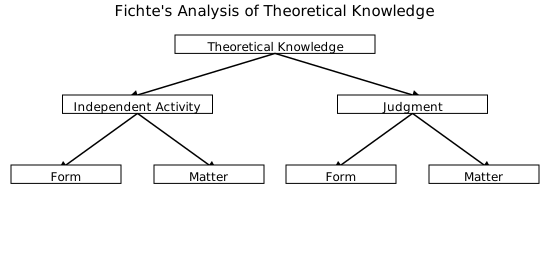
The analysis can also be rearranged to reflect the method of intermediaries (Mittelglieder) outlined in the Note to §4.D (see Fichte's method of intermediaries for more details):
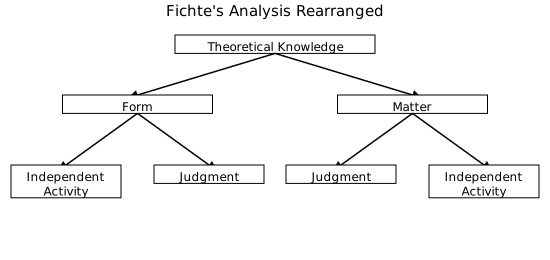
Fichte's analysis of judgment is flawed in two respects:
- Fichte creates these independent entities, the "independent activity" of mind and world. His intention is to dissolve this dualism through synthesis, but he ought not to have even entertained their possibility in the first place.
- The process of synthesis involves synthesizing each branch via "interdetermination" (Wechselbestimmung). The method of synthesis, "interdetermination" is separate from the act of analysis.
Hegel fixes these shortcomings. The game of forces has this structure:
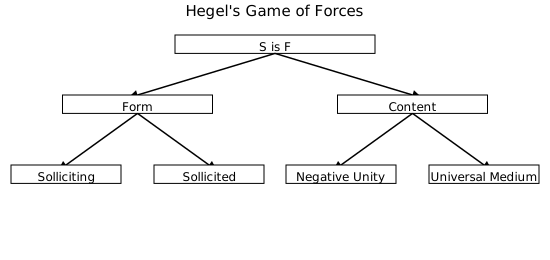
Form does not refer, as it does in Fichte's Wissenschaftslehre, to the mind as substance ("die unabhängige Tätigkeit der Form") or to the unity and difference of a proposition ("die Form des Wechsels"). It refers to the method of synthesis, Fichte's "interdetermination". Fichte's method of interdetermination works as follows:
- Not: F determines M
- Not: M determines F
- Rather: M and F determine one another
Hegel calls interdetermination "soliciting":
- K1 solicits K2: "die Kraft, welche sollizitiert wird von einer anderen Kraft"
- K2 solicits K1: "ebenso das Sollizitierende für diese andere [sollizitierte Kraft]"
- K1 and K2 solicit and are solicited by one another: "welche [als die zuerst sollizitierende Kraft] selbst erst hierdurch sollizitierende wird."
Here is Fichte's formulation: "Die Möglichkeit, ein Seyn an sich von einem Seyn im Wechsel abzusondern, wird geläugnet: beide sind gesetzt als Wechselglieder, und sind ausser dem Wechsel gar nicht gesetzt."
Here is another of Fichte's formulations of the totality of interdetermination: "das eine Accidens ist jedesmal sein eigner und des entgegengesetzten Accidens Träger, ohne dass es dazu noch eines besonderen Trägers bedürfte."
There is no "soliciting power" outside of it, at the same time, being "solicited". Putting Hegel and Fichte together: Ausser dem Wechsel der sollizitierenden und sollizitierten Kräfte sind die Kräfte gar nicht gesetzt.
The "form" of the "game of forces" is the form of the unity of S is F, which is to say, the interdetermination of "S" and "F".
Also in Hegel's play of forces, there is not the "independent activity" of the mind or the world. There is no mind, any more than there is a world. The mind constitutes itself at every moment anew in the act of making a judgment of the form "S is F", in the act of uniting the "negative unity" of the grammatical subject with the "universal medium" of predicates ("Das denkende, vorstellende, Subjekt gibt es nicht" - TLP 5.631). Likewise, the world is constituted anew, for me, in every act of a judgment of the form "S is F" ("Die Grenzen meiner Sprache bedeuten die Grenzen meiner Welt." TLP 5.6)
The unity of the canonical form consists of the unity and difference of the positive and negative form of the canonical form (Kimhi's syncategorematic unity of the contradictory pair): "was in diesem absolute Wechsel ist, ist nur der Unterschied als allgemeiner oder als ein solcher in welchen sich die vielen Gegensätze reduziert haben."
There is no judgment, save through combination. This is the synthesis of the "negative unity", the grammatical subject "S", with the "universal medium", the predicate "F". All combinations are possible. All combinations are either true or false. The absolute unity of the combination of S with F is only possible between S is F is either true or false.
That a proposition is either true or false is the Law of the Power ("das Gesetz der Kraft").
Fichte claimed the same, when he referred to a proposition as "an exchange of activity and passivity" (Wechseltun- und Leiden). The proposition S is F is either true (active) or false (passive), and likewise for S is not F.
The Game of Laws
There is one Supreme Law of the Power, and that is that any proposition of the form S is F is either True or False.
One application of the Supreme Law is the logical atomism that Wittgenstein presented in his Tractatus. Any proposition p can be true or false, independently of any other proposition q.
The mathematical representation of this is an S x F matrix, i.e. every possible S is combined with every possible F, that takes the values True or False, 1 or 0. We can call this the Universal Matrix of S x F:
| F1 | F2 | F3 | ... | Fn | |
|---|---|---|---|---|---|
| S1 | 1 | 0 | 1 | ... | 0 |
| S2 | 0 | 1 | 0 | ... | 1 |
| S3 | 1 | 1 | 0 | ... | 0 |
| ... | ... | ... | ... | ... | ... |
| Sm | 0 | 0 | 1 | ... | 1 |
The other application of the Supreme Law is Logical Dependence. It says that for all propositions p1, p2...pn, the truth of any one of those propositions pi implies the falsity of all the other propositions: p1...pi-1, pi+1...pn.
The mathematical representation of this is the set of real numbers R, which can be represented as a 1 x 1 matrix whose single entry can be any real number. (Note that the one true value, surrounded by infinite false values is a hint that S is F says more than S is not F).
Some combinations of predication lean more toward logical atomism, others toward logical dependence:
- Logical atoms: The object can be green or not green, as well as cubic or not cubic.
- Logical dependence: If the object is red, it is not green. Colors are points along a number line. The set of numbers can be coarse (red, yellow, blue, green, etc) or fine (Pantone #15–5519). This is McDowell's point in Mind and World: "one can give linguistic expression to a concept that is exactly as fine-grained as the experience, by uttering a phrase like 'that shade'."
(Wittgenstein didn't reject logical atomism any more than he embraced it. He could see in color just like anyone else.)
Once we have the distinction between Logical Atomism and Logical Dependence as the two limiting configurations of the Supreme Law of the Power, we can understand Hegel's commentary on the Law of the Power.
"Zu dem einfachen Unterschiede wird die absolut wechselnde Erscheinung durch ihre Beziehung auf die Einfachheit des Innern oder des Verstandes."
An appearance takes the canonical form S is F. Either the proposition S is F is true or it is false. The appearance as the judgment S is F or S is not F is therefore "alternating" (wechselnd), and its alternation is absolute, closed within itself. The appearance of the form S is F is closed within itself in the sense that S is F contains (Fichte says "carries") its contradiction S is not F (Kimhi's syncategorematic unity of the contradictory pair).
The appearance becomes the "simple difference" when we consider that only one of the two judgments "S is F" and "S is not F" is true, and the other false. We pierce through mere appearance, the mere possibility that S is F, when we see that S is F is true (or false as the case may be). The truth of S of F, the truth (or falsity) of any and all propositions of the form S is F is the "simplicity of the Inner", the "Simplicity of the Understanding". The understanding says what is the case. The understanding comes down on one side of the truth or falsity of S is F. It affirms S is F, and thereby excludes S is not F. The alternations of appearance settle down in their orientation to the Truth.
"der Wechsel, als im Innern gesetzt, wie er in Wahrheit ist,...in dasselb hiemit alsebenso absolut allgemeiner, beruhigter, sich gleich bleibender Unterschied..."
"Oder die Negation ist wesenliches Moment des Allgemeinen, und sie oder die Vermittlung also im Allgemeinen ist allgemeiner Unterschied."
"Oder" is meant in the sense of "sive", or "that is to say", "in other words". Hegel is just repeating himself, showing the same idea from different formulations.
Negation ⇔ the essential moment of the universal ⇔ the mediation in the universal ⇔ universal difference.
The "universal" - that is language, which has the canonical form S is F. Negation is the "mediation" (Vermittlung) of language, in language. What is said in language can be either true or false. Language that says what is, that knows no negation, is the universal closed into itself. It is open to the world, it mediates the world, it mediates itself via negation. Human's only know language with negation. Negation is "universal difference". Negation is not the negation of this or that claim. It is the negation of any claim at all. It is the negation without which there would not be any claim at all. For a claim is that which can be true or false.
"Er ist im Gesetze ausgedrückt, als dem beständigen Bilde der unstetten Erscheinung."
The Supreme Law says that every proposition is either true or false. Behind the uncertainty of whether S is F or S is not F lies the certainty of which one of the contradictory pair is the case.
"Die übersinnliche Welt ist hiemit ein ruhiges Reich von Gesetzen, zwar jenseits der wahrgenommenenen Welt, denn diese stellt das Gesetz nur durch beständige Veränderung dar, aber in ihr eben so gegenwärtig, und ihr unmittelbares stilles Abbild."
The laws ("Gesetze") are not, in the first instance, laws in the general sense, but rather statutes, stipulations, positings. Every claim of the form S is F is its own law, its own statute (i.e. ein Gesetz ≈ ein Gesetztes).
The supersensuous world is the world of all true propositions, in which the flip-flopping of uncertainty regarding what is the case, has been resolved.
Our world, the perceived world, only presents what is the case through propositions that may be true or false ("beständige Veränderung"). That every proposition is either true or false means that the supersensuous world as the correct resolution of the question p or ¬p is present in (gegenwärtig) the unresolved proposition (p or ¬p) itself.
"das Reich von Gesetzen": Note that the objective and subjective genitive in their difference and unity are the expression of monism.
- the realm that contains all stipulations
- the realm that is constituted by all stipulations, as a lake (the Welt) is fed by its source (the many stipulations)
- "Die Welt ist die Gesamtheit der Tatsachen..."
"Dieses Reich der Gesetze ist zwar die Wahrheit des Verstandes, welche an dem Unterschiede, der in dem Gesetze ist, den Inhalt hat;"
A developed understanding is one that can articulate why S is F and not not F.
"The truth of the understanding":
- What the understanding truly is, is its ability to say that S is F and not not-F.
- The truth that issues forth from the understanding is manifest in a person understanding why S must be F and not not-F.
An understanding applies the Universal Difference that is articulated by the Supreme Law (der Unterschied, der in dem Gesetze ist) to each and every claim of the form S is F.
A developed understanding is one that has a body of knowledge (content, Inhalt) that allows it to articulate why S is F must be so. (Rödl's "interminable progression from assertoric to apodictic modality".)
"...es [=das Reich der Gesetze] ist aber zugleich nur seine [= des Verstandes] erste Wahrheit, und füllt die Erscheiung nicht aus."
To "realm of laws" would "fill out appearances" if it could show for every claim S is F whether, and why it is true or not.
Hegel thinks that such a perfect understanding that knows, and can explain every fact about the world, is a priori impossible, and that is because knowing what is True is only the "first truth" of the understanding. The deeper truth of the understanding that grounds the "first truth" of the understanding is not the True, but the Good.
"if a man could write a book on Ethics which really was a book on Ethics, this book would, with an explosion, destroy all the other books in the world"
However, this is merely an anticipation of what is to come.
"Das Gesetz ist in ihr gegenwärtig, aber es ist nicht ihre ganze Gegenwart; es hat unter immer andern Umständen eine immer andere Wirklichkeit."
The Supreme Law of Truth and Falsity is present in every appearance, every claim of the form S is F, for every claim is either True or False. However, we cannot say for any and every proposition S is F whether it is indeed True or False. The truth or falsity of the claim "S is F" is not entirely present to us ("es ist nicht ihre ganze Gegenwart"). Every claim "S is F" is a particular claim about this S and this F. We cannot exhaustively model empirical reality with empirical laws.
"Dieser Mangel des Gesetzes muß sich an ihm [dem Gesetz] selbst...hervortun."
Just as the appearance, in the form of the claim "S is F", can, despite our vast knowledge of the world, turn out to be false, so, too, does that Supreme Law that says that everything claim is either true or false lack the ability to say which claims are true and which claims are false: "Was ihm [dem Gesetz] zu mangeln scheint, ist, daß es zwar den Unterschied selbst an ihm hat, aber als allgemeinen, unbestimmten."
"p or ¬p" Wittgenstein would call a tautology (TLP 4.46). It is a "universal, undetermined difference". It says nothing about the world: "Tautologie und Kontradiktion sind sinnlos." (TLP 4.461)
"Insofern es aber nicht das Gesetz überhaupt, sondern ein Gesetz ist, hat es die Bestimmtheit an ihm; und es sind damit unbestimmt viele Gesetze vorhanden."
The Supreme Law (das Gesetz überhaupt) is the law that every claim must be true or false. A single law is the claim S is F as that which is true, that which must be true. The supreme law, which is undetermined, i.e. a tautology, becomes determined, i.e. acquires sense (Sinn), via a particular law that S is F (das Gesetz überhaupt hat die Bestimmtheit an dem einen Gesetz).
"Allein diese Vielheit ist vielmehr selbst ein Mangel; sie widerspricht nämlich dem Prinzip des Vestandes, welchem als Bewußtsein des einfachen Innern die an sich allgemeine Einheit das Wahre ist. Die vielen Gesetze muß er darum vielmehr in Ein Gesetz zusammenfallen lassen."
Unity (Einheit) is Truth. It is the Truth Maker, according to which any proposition S is F is either True or False. It is the "simple inner" in which the flip-flopping of truth or falsity of the S is F is resolved. It is a "universal that is in itself" (an sich allgemein) because Truth is never directly accessible to language, it is not a "universal that is for itself", rather truth always lies beyond the proposition S is F as that towards which S is F orientates itself and that which decides over the fate of S is F.
Each and every proposition, of the canonical form S is F, needs to find its orientation as either pointing from or away from truth. When all propositions of the form S is F are correctly resolved, we have the set of all true propositions in the form S1 is F1, S2 is not F2, etc. The set of all true propositions is the unity of truth.
According to the model of logical atomism, each and every proposition is true or false independent of another proposition. (Wittgenstein: "Es gibt nur eine logische Notwendigkeit.") If this were the case, no judgment of the form S is F would have any implication for another judgment of the form S is F. Hegel calls this "das gedankenlose Vorstellen...welchem alles in der Gestalt der Zufälligkeit sich darbeitet, und welchem die Bestimmtheit die Form der sinnlichen Selbstständigkeit hat." Under such a regime, that is no regularity to experience, only isolated (atomic) claims "S is F", each "self-standing" (selbstständig).
However, it turns out that, in the matrix of all possible combinations of S's with F's, regularities are present. Mathematics suggests that this is more than just a coincidence. In the moment I can apply the logic of numbers to my understanding of the world, I break Logical Atomism ("The tree as two branches" implies it doesn't have three, or four branches, etc.), and employ Logical Dependence.
(In the Tractatus, Wittgenstein derives numbers from the logical operation of negation. This suggests that he does not, as is commonly suggested, subscribe to a theory of logical atomism as a theory about the structure of the world. Such a claim implies not only that he didn't know what colors are, but also that he didn't think that arithmetic had any application in our knowledge of the world. Both assumptions are prima facie absurd.)
Any regularity, that allow us to infer the truth of one proposition from the truth of another proposition, is what Hegel refers to as "the One Law in which the Many Laws fall together." (Die vielen Gesetze muß [der Verstand]...in Ein Gesetz zusammenfallen lassen.)
The many elementary propositions, propositions of the canonical form S is F, fall together in a law. For example, the positions of a falling stone at various times t can be formulated in the canonical form: , The stone is at position p1. This proposition is already a law in the sense that it implies the truth or falsity of a whole set of other propositions: The stone is NOT at position p2, etc.
However, there are even higher laws that create ever more general relations among propositions, for example, Newton's Law of Gravity: given the stone's position and velocity at time t1, we can infer the stone's velocity and position at any other time tn. And this law applies not just to stones, but any falling object on earth, and, finally, any moving body in the universe: "Die vielen Gesetze Gesetze muß er [der Verstand]...in Ein Gesetz zusammenfallen lassen."
"Mit diesem Ineinanderfallen aber verlieren die Gesetze ihre Bestimmtheit; das Gesetz wird immer oberflächlicher, und es ist damit in der Tat nicht die Einheit dieser bestimmten Gesetze, sondern ein ihre Bestimmtheit weglassendes Gesetz gefunden."
The law of gravity, that describes the position of this falling stone at time t, abstracts away nearly everything about this stone, viz. that it is a stone, its color, how it got there, etc. If the "determinate laws" (diese bestimmten Gesetze) are all the things we can say about this stone, then the law of gravity has abstracted away most of those propositions. Indeed, the law of gravity abstracts all the way out to the heavens, treating a stone and a planet as equivalent: "...das Eine Gesetz, welches die Gesetze des Falles der Körper an der Erde, und der himmlischen Bewegung in sich vereint, [drückt] sie beide in der Tat nicht aus[...]."
A law of nature abstracts from certain kinds of combinations: "The stone has dirt on it", in favor of others: "The stone is currently falling at a velocity of n." so as to identify relations of Logical Dependence amount various propositios of the Canonical Form. This is why Wittgenstein calls them "nets": "Den verschiedenen Netzen entsprechen verschiedene Systeme der Weltbeschreibung" (TLP 6.341). The net of Newton's gravitation law says nothing about this stone, with this speck of dirt on it: "Wir dürfen nicht vergessen, dass die Weltbeschreibung durch die Mechanik immer die ganz allgemeine ist. Es ist in ihr z. B. nie von bestimmten materiellen Punkten die Rede, sondern immer nur von irgend welchen." (TLP 6.3432)
"Die Vereinigung aller Gesetze in der allgemeinen Attraktion drückt keinen Inhalt weiter aus, als eben den bloßen Begriff des Gesetzes selbst, der darin als seiend gesetzt ist."
There are two senses of attraction under consideration
- electromagnetic attraction, in which a magnet points toward the North Pole and away from the South Pole
- the resolution of the syncategorematic unity of the contradictory pair, in which the a combination of "S" and "F" points either toward truth (S is F) or toward falsity (S is not F).
Electromagnetic attraction is a law of nature. Insofar as all of nature can be said to exist in a magnetic field, they all of nature orients itself relative to this magnetic field. This would be, in theory, be the highest fundamental natural law, as it abstracts from all other natural laws, and the laws and atomic propositions contained therein, and poses the highest principle, the most general regularity in the Game of Combination, the Truth and Falsity of atomic facts.
However, the "universal law of attraction" is the attraction of every proposition toward Truth, i.e. the resolution of the contradictory unity S is F and S is not F. As such, it says nothing about the world: "Die Vereinigung aller Gesetze in der allgemeinen Attraktion drückt keinen Inhalt...aus". Instead, the universal law of attraction, which is, of course, the Supreme Law of Truth and Falsity mentioned above, is the law according to which any proposition qua proposition conforms. It is the "mere concept of the law itself".
Insofar as we claim that this concept of Truth and Falsehood finds its correlate as a contentful law of the physical world, via a unified physical theory of the universe in terms of electromagnetism, then we, to that extent, assert that the bipolarity of Truth and Falsity exists, not as a condition for having a world at all, but rather in the world in the guise of electricity and magnetism. The "mere concept of the law itself is posited as existing" in the physical law of attraction.
This move is questionable. It violates the strict division between, on the one hand, the logical conditions for the possibility of experience, for furnishing any proposition about the world at all, and, on the other hand, a particular proposition about the world: "Der Verstand meint dabei, ein allgemeines Gesetz gefunden zu haben, welche die allgemeine Wirklichkeit als solche ausdrücke; aber hat in der Tat nur den Begriff des Gesetzes selbst gefunden."
And yet, the move is also desirable, for it suggests that we can, via the principle of Logical Dependence infer the truth of one judgment p on the basis of another judgment q. It is a move against the chaos of Logical Atomism: "Der Ausdruck der allgemeinen Attraktion hat darum insofern große Wichtigkeit, als er gegen das gedankenlose Vorstellen gerichtet ist, welchem alles in der Gestalt der Zufälligkeit sich darbietet..." (Compare: "Die Welt ist alles war der Fall ist". Every fact about the world is a coinflip that lands heads (True) or tails (False). "Es gibt nur eine logische Notwendigkeit." Necessity is not a feature of the natural world. The world is just the sum of all co-incidences.)
The aspiration of the law of attraction is that experience is shot through with a magnetic field, and that studying that field at any point p, with reveal the Truth or Falsity of a particular claim S is F.
However, this is a dream. For even if such a physical field of polarity existed, it would say something about the magnetic orientation of an object, but little, for example, about any else concerning the object. It is a law that leaves behind the "determinateness" of "determinate laws", laws, propositions, which concern this or that particular object ("das Gesetz wird immer oberflächlicher, und es ist damit in der Tat nicht die Einheit dieser bestimmten Gesetze, sondern ein ihre Bestimmtheit weglassendes Gesetz gefunden.").
Furthermore, the seduction of "lawfulness" (Gesetzmäßigkeit) can draw one into the delusion that the truth of a single proposition could be confirmed by its conformity to a more general law. This is the Myth of Coherentism, and it will be dispelled shortly with the Myth of the Inverted World. For coherentism cannot answer the question of why our interlocking judgments are not all false, rather than all true.
"Es steht somit den bestimmten Gesetzen, die allgemeine Attraktion, oder der reine Begriff des Gesetzes, gegenüber."
The "general law of attraction" is the same as "the pure concept of the Law", the Supreme Law of the Power, which is that every proposition is either true or false.
Any "determinate law" is a claim about one or more combinations in the universal matrix of S x F being true or false. An atomic proposition, the simplest form of law, says that one particular combiantion "S is F" is true or false. Laws in the more common sense, such as the Law of Gravity, define an entire set of atomic propositions to be true or false together, at once. Note that universal laws, such as the Law of Gravity, or "all dogs are mammals" are like nets that float freely over the Universal Matrix S x F, locking in with the help of another proposition, such as "This here is a dog", or "This stone is currently falling at a velocity of n."
"Insofern dieser reinen Begriff, als das Wesen, oder als das wahre Innere betrachtet wird, gehört die Bestimmtheit des bestimmten Gesetzes selbst noch der Erscheinung oder vielmehr dem sinnlichen Sein an."
Truth and falsity are the "true inner" of laws. We set up laws in order to make claims that are either true or false. Any law, save the Supreme Law of the Power, is going to be the formulation of a single truth claim, a proposition, or a set of propositions. These propositions are not true in themselves. If they were, they wouldn't be truth claims.
Because any law is a statement of one or more propositions, we must look to experience to confirm its truth or falsity. "Es gibt nur eine logische Notwendigkeit" (TLP 6.37). The reason the Law of Gravity is true is because we find it to be confirmed in observing the movement of bodies in time and space. The Law of Gravity, in its determinateness "belongs to appearances, or rather, sensuous being."
"Allein der reine Begriff des Gesetzes geht nicht nur über das Gesetz, welches, selbst ein bestimmtes, anderen bestimmten Gesetzen gegenübersteht, sondern er geht auch über das Gesetz als solches hinaus."
Laws belong to experience on account of their determinateness. For example, the Law of Gravity is a function of the distance squared (r2) and not, for example, the distance squared minus the distance (r2-r) because our observation of the empirical world has borne out the former formula and not the latter. Thus, experience allows us to separate out the correct laws from the incorrrect laws.
This applies to any concievable law, any law "as such", and not just to the particular laws we consider. It is a universal feature of laws that they can be true or false. The Supreme Law of the Power, however, stands outside of any of these conceivable laws. The Sumpreme Law of the Power is the statement of what any law, qua law is. A law is a statement which can be true or false, or, to say the same thing differently: a law is a statement by which we determine something (or many things in the case of general laws) to be true or false.
Laws are the formulation of propositions, which are either true or false. Laws are statements of the Canonical Form S is F and statements describing dependencies about various statements of the Canonical Form S is F. Laws allow us to say true things, and it is an account of truth, an account of knowledge, an account of the Canonical Form, that is at stake here: "denn es ist nur das Gesetz als das Wahre vorhanden". The formulation of a law is, when we are lucky, the formulation of something that is true.
"...der Begriff des Gesetzes ist gegen das Gesetz selbst gekehrt."
The concept of law, the Supreme Law of the Power turns against any particular law as the condition of any law as such. It stands outside of any particular law as the rule to which any law must conform.
The history of modern logic is an attempt to violate this strict hierarchy of the Supreme Law over all over laws. Truth (and falsity) cannot be a component of a law itself. Truth and falsity are the conditions according to which a law is a law at all.
Examples:
-
S is F is true. "is true" is superfluous. It adds nothing to the canonical form. Frege claims, against all reason, that an assertion mark (Urteilsstrich) is necessary to assert the truth of a proposition: ⊢(S is F).
-
True and False have no place in mathematical formulas. Frege, for example, suggests this monstrosity: "(22 = 4) = (2 > 1)". It is based on the notion that a mathematical equation reduces to the "value" True or False.
-
Gödel's Incompleteness Theorem provides a rigorous proof of the impossibility of violating the supremity of the Supreme Law of the Power. Eventually you'll reach an unprovable statement. (Perhaps the formal validation of proofs is useful, up to a certain point. My hypothesis is that such formal validation is simply the expansions and contractions of formal logic.)
"An dem Gesetze nämlich ist der Unterschied selbst unmittelbar aufgefaßt und in das Allgemeine aufgenommen, damit aber ein Bestehen der Momente, deren Beziehung es ausdrückt, als gleichgültiger und an sich seiender Wesenheiten."
The "difference" (Unterschied) that is "immediate" (unmittelbar) is the difference between 'S' and 'F' of the Canonical Form "S is F". The two different things, "S" and "F" are combined, "taken up" in the form "S is F". It thus appears that "S" and "F", as the two terms of the Canonical Form, stand for two separate things. This is an illusion.
The Canonical Form grabs a fact, and holds onto it, in the form "S is F": "Was der Fall ist, die Tatsache, ist das Bestehen von Sachverhalten" (TLP 2) The "Sachverhalt", the "atomic fact" as it is called in the English translation, is the Canonical Form S is F, that only says something about one and only one element in the Universal Matrix S x F. A "Tatsache" (fact), just like Hegel's "Gesetze" can be composed of one or more atomic facts.
"Der Sachverhalt ist eine Verbindung von Gegenständen." (TLP 2.01) "S" and "F" are the objects so combined.
"Das Ding ist selbständig, insofern es in allen möglichen Sachlagen vorkommen kann, aber diese Form der Selbständigkeit ist eine Form des Zusammenhangs mit dem Sachverhalt, eine Form der Unselbständigkeit." (TLP 2.0122)
"S" and "F", the "things" (Dinge) appear to be "an sich seinder Wesenheiten." This is an illusion: "Diese Form der Selbständigkeit ist eine Form des Zusammenhangs...eine Form der Unselbstständigkeit."
This is Kimhi's point about categorematic terms. They exist, but only in the form of a syncategorematic judgment.
"Die Teile des Unterschieds am Gesetze sind aber zugleich selbst bestimmte Seiten; der reinen Begriff des Gesetzes, als allgemeine Attraktion muß in seiner wahren Bedeutung so aufgefaßt werden, daß in ihm als absolut Einfachen die Unterschiede, die an dem Gesetze als solchem vorhanden sind, selbst wieder in das Innre als enfache Einheit zurückgehen; die ist die innre Notwendigkeit des Gesetzes."
"S" and "F" are the two "determined sides" (bestimmte Seiten) of the Canonical Form. When they enter into a combination, their combination is now capable of being true or false. This is the capability of "the pure notion of the law", "universal attraction", the polarity of True and False, the Supreme Law of the Power.
The Canonical Form is a unity, an absolute unity (absolut Einfaches). Any law, qua law, requires a combination. This combination is the "innre Notwendigkeit des Gesetzes".
"In der Logik ist nichts zufällig..." (TLP 2.012) The logical combination of "S" and "F" in "S is F" is not coincidental. Only the truth value of a particular combination is coincidental. The possibility of the combination of "S" with "F" is logically necessary. It is "inner neccesity of the law."
Summary
We have come to the point at which "the concept of the law has turned against the law itself" (der Begriff des Gesetzes ist gegen das Gesetz selbst gekehrt). Hegel is now going to explain this opposition as the opposition between two laws, laws that we can call Difference Laws:
- First Difference Law (das Gesetz): The "concept of the law" (der Begriff des Gesetzes), i.e. the Supreme Law of the Power, which is that every proposition is either True or False. Hegel also calls this "universal difference" (allgemeiner Unterschied) and "universal attraction" (allgemeine Attraktion)
- Second Difference Law (das zweite Gesetz): The law of combination. The simplest form of combination is the combination of "S" and "F" in the Canonical Form "S is F". The next four paragraphs are going to explain that this is a "difference that is not a difference in itself" ("kein Unterschied an sich selbst").
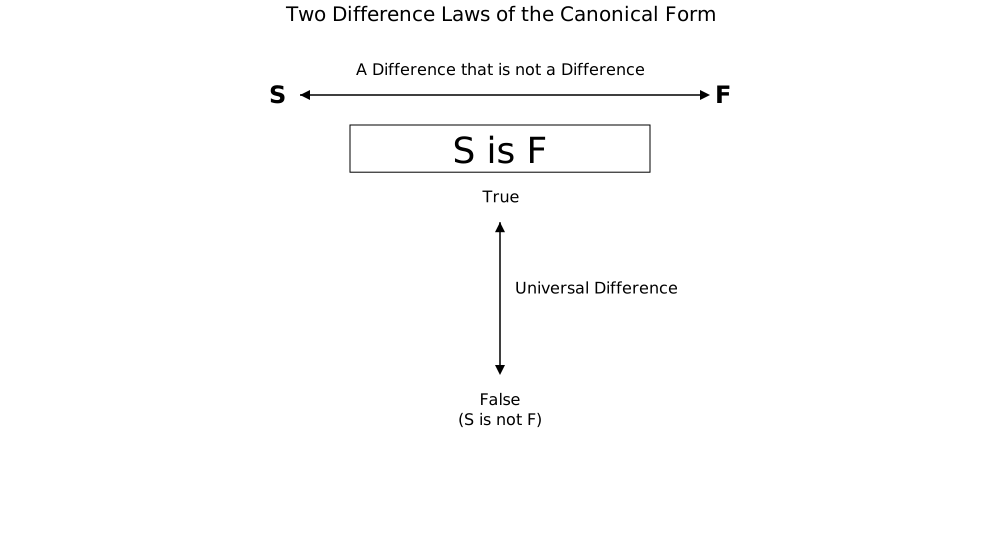
Once Hegel explains the Second Difference Law, he is going to construct the Inverted World. The Inverted World is a monstrosity. It results from combining two axes of difference (the First and Second Difference Laws) that we try to hold apart. Normally try to hold them apart as follows:
- First, we make a combination "S is F" (Second Difference Law)
- Second, we ask if the combination is True or False (First Difference Law)
In fact, we don't hold these two axes apart. Holding the axes apart would be separating force (First Difference Law) from content (Second Difference Law). Considering we don't hold the act of combination apart from its assertion as True or False, we now ask: "Why are some combinations then True and others False?" We don't have an answer to this at this point. Because we don't have an answers, we do sometime silly, something "thoughtless" (Der Begriff mutet der Gedankenlosigkeit zu, beide Gesetze zusammenzubringen). The skeptic has emerged. It questions why things are as they are, why S is "F" and not "not F", or not "G". We poses this question as the Inverted World. (This reply to the skeptic that will lead us out of the Inverted World will be: "The Good is Good").
Why do we need to combine these two Difference Laws to create the Inverted World?
- The First Difference Law can only give us contradictories: "The sky is red" or "The sky is not red." We cannot build an alternative world simply out of negation: "Everything is the negation of what I say it is." This is because negation is indeterminate. It says what is not the case, but a world is everything that is the case.
- The Second Difference Law alone can only give us contraries. In addition to combining "S" with "F", we can also combine "S" with "G". This gives us a world where "The sky is blue" and "The sky is red" and "The sky is green". This world is also not a world. It is over-saturated.
- The two Difference Laws together allow us to construct an alternative world. In the alternative world, we assert one of the contraries: "The sky is red" and deny the others "The sky is blue", "The sky is green", etc. Truth and Falsity (First Difference Law) desaturate the oversaturation of conflicting contraries, and the Fullness of Combination (Second Difference Law) gives our alternative world determinacy.
The Second Difference Law
Hegel describes the Second Difference Law in two ways ("Das Gesetz ist dadurch auf eine gedoppelte Weise vorhanden"):
- Unity: in terms of the unity of the proposition "S is F" that only exists as the unity "S is F":
[die] Form des einfachen in sich Zurückgegangenseins
- Independence: in terms of the apparent independence of "S" and "F", two elements that are, apparently, later combined to form the law "S is F":
das...Gesetz, an dem die Unterschiede als selbständige Momente ausgedrückt sind
Hegel's two examples of laws are electricity and gravity. Why these as examples? Why not a simple law such as "The cube is salty"? Hegel has chosen the most general empirical laws he can find - two laws that claim to have a grasp on all physical objects. All physical objects can be described in relation to gravity and in relation to an electric field. One possible reason is that Hegel is out to show that the components of a combination that constitutes a proposition, i.e. the "S" and "F" of "S is F" are theoretical entities. They don't exist for thinking, save within a propositional combination. This claim in more intuitive when applied to theoretical physics. We are more ready to accept the theoretical nature of time and space than we are ready to accept the theoretical nature of a simple object such as a grain of salt.